
Our Story
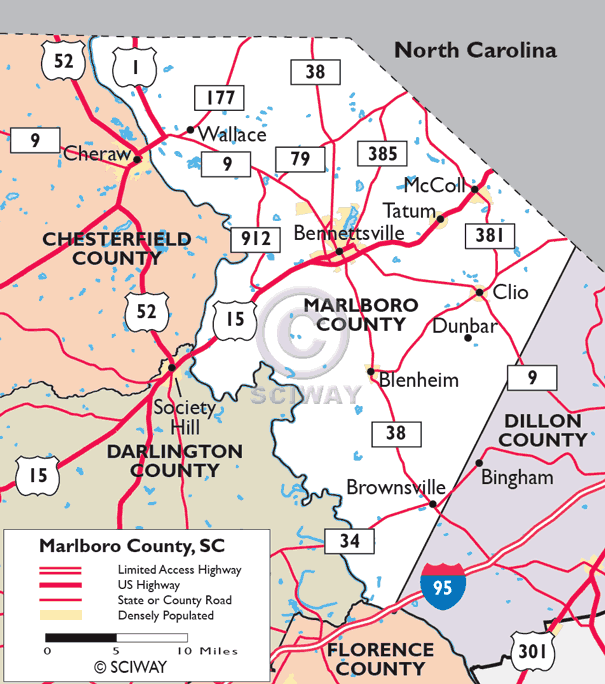
Every community has a story. Marlboro County's begins long before county lines were ever drawn.
For thousands of years, Native American peoples lived throughout this region, drawn by the fertile land, forests, and waterways of the Great Pee Dee River basin. Their presence laid the earliest chapter in a history shaped by the land itself.
Marlboro County was officially established in 1785 as one of South Carolina's original counties following the American Revolution. It was named after the Duke of Marlborough, honoring the British title that had become familiar throughout the American colonies. In 1819, the county seat was moved to the newly established town of Bennettsville, creating the civic heart that still serves the county today.
Throughout the nineteenth century, agriculture defined life in Marlboro County. The county's exceptionally fertile soil made it one of South Carolina's premier cotton-producing regions, bringing prosperity that fueled the growth of farms, businesses, churches, and beautiful homes that still grace the landscape.
Like much of the South, Marlboro County endured the hardships of the Civil War and the challenges of rebuilding afterward. The arrival of the railroad in the late 1800s opened new opportunities for commerce and industry, helping local communities connect with markets across the Southeast.
During the twentieth century, the county became known not only for agriculture but also for textiles, manufacturing, education, and a strong tradition of entrepreneurship. Its towns developed distinct personalities while remaining closely connected by generations of families who have called this area home.
Today, Marlboro County is a place where history and progress meet. Visitors can explore historic districts, Revolutionary and Civil War sites, museums, scenic rural landscapes, and welcoming small towns that proudly preserve their heritage while embracing the future.
Whether you're tracing your family's roots, starting a business, or simply passing through, you'll find that Marlboro County offers something increasingly rare: authentic Southern hospitality, a rich historical legacy, and a community that values its past while building for tomorrow.
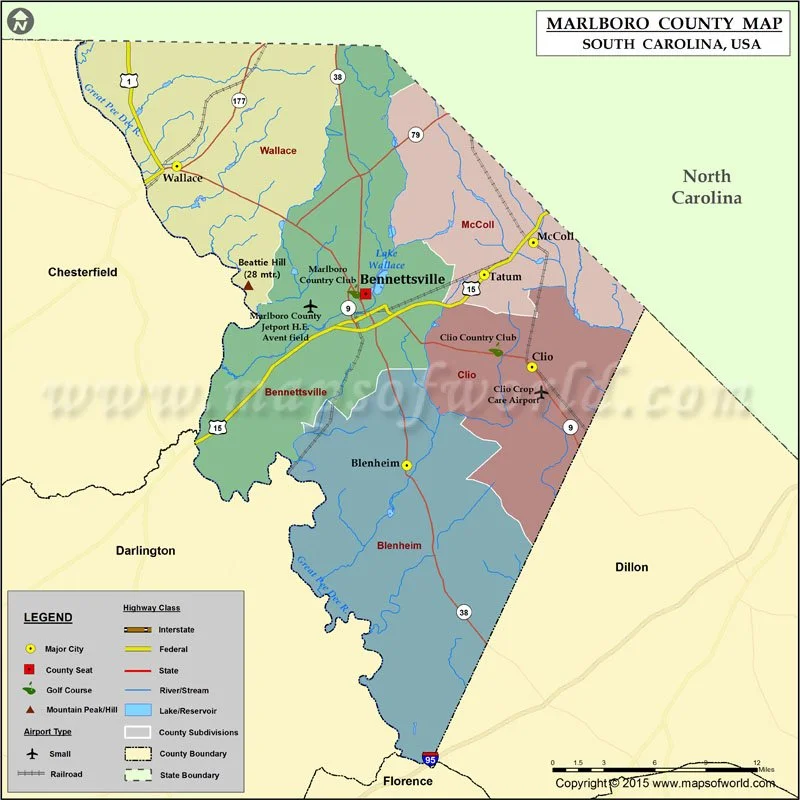
Where History Still Walks Down Main Street
Some towns are built. Others seem to grow naturally from the land around them. Bennettsville is a little bit of both.
Long before storefronts lined Main Street and church bells echoed through town, this corner of South Carolina was home to Native American communities who lived along the fertile banks of the Great Pee Dee River. The rich soil, abundant wildlife, and winding waterways made this region an ideal place to settle.
Fast forward to 1819, and South Carolina's leaders decided Marlboro County needed a more centrally located county seat. They selected a high bluff overlooking Crooked Creek, laid out a town around a courthouse square, and named it after Governor Thomas Bennett, Jr. What began as a practical decision would soon become one of South Carolina's most prosperous communities.
If you've ever heard someone joke that "the land around here is so rich it was sold by the pound instead of the acre," you're hearing one of Bennettsville's oldest legends. While not literally true, it captures an important fact: the fertile farmland surrounding the town made it one of the wealthiest agricultural regions in South Carolina during the 1800s. Cotton became king, and the courthouse square quickly filled with merchants, lawyers, doctors, and businesses serving a growing community.
Then came the Civil War.
In March 1865, Union forces under General William Tecumseh Sherman marched into Bennettsville during the final weeks of the conflict. Much of the surrounding area suffered damage, yet the county courthouse survived. That stroke of fortune preserved county records dating back to 1785, making Bennettsville one of the few places in South Carolina where generations of family history remain remarkably intact. Today, genealogists from across the country still visit in search of their roots.
Like many Southern communities, Bennettsville reinvented itself after the war. The arrival of the railroad in the 1880s connected local farmers and businesses to new markets, bringing banks, textile mills, cotton exchanges, and new opportunities. Elegant Victorian homes and stately public buildings rose throughout town, many of which still stand today as reminders of an era of remarkable growth.
But Bennettsville's story isn't complete without "The Gulf."
For nearly a century, Market Street was home to a thriving African American business district where entrepreneurs, physicians, pharmacists, educators, attorneys, ministers, musicians, and shop owners built successful businesses despite the barriers of segregation. The Gulf became much more than a commercial district. It was a cultural heartbeat where families gathered, music filled the streets on weekends, and a strong sense of community flourished. Today, its legacy remains one of resilience, determination, and local pride.
History lovers often discover that Bennettsville is full of surprises. More than 40 historical markers throughout Marlboro County tell stories of Revolutionary War skirmishes, Civil War movements, remarkable local citizens, and architectural treasures. Every block seems to have a story waiting to be uncovered.
Today, Bennettsville blends historic charm with small-town hospitality. Stroll through our walkable downtown, admire beautifully preserved homes, explore local shops and restaurants, visit museums, or simply spend a few minutes talking with the people who call this place home. You'll quickly discover that our greatest landmark isn't a building. It's our community.
Bennettsville has weathered wars, economic booms, changing industries, and more than two centuries of American history. Through it all, one thing has remained constant: a spirit of resilience, neighborliness, and pride that continues to welcome everyone who visits.
Whether you're here for an afternoon, a weekend, or a lifetime, we're glad you've found your way to Bennettsville. We think you'll find that history doesn't just live here.
It still has a front porch.